Every storage idea you find for a house assumes the room stays where you put it. An RV does not. The same cupboard gets shaken for hours, leaned on through corners, and dropped an inch every time a wheel finds a pothole.
So the question is not how much you can fit. It is whether it stays where you put it, and whether where you put it makes the vehicle worse to drive.
Latches first, because everything else depends on them
Before loading anything, close every door and drawer and check it actually latches. A lot of factory hardware is a thin plastic flap that engages weakly and wears loose, and a latch that opens once on a corner will scatter the contents of that cupboard across the floor.
What works is a mechanical latch that snaps shut with some authority, so you can feel and hear it engage. Child-safety latches, the hook-and-catch type, are a common retrofit and are rated to hold a meaningful load. Positive catches on drawers matter more than on doors, because a drawer that opens under braking carries its own weight into the aisle.
Test with the vehicle loaded, not empty. A drawer that latches fine holding nothing behaves differently with four kilograms of tinned food behind it, particularly if that weight can slide forward and shove the drawer front from inside.
Fill the voids
The second failure mode is contents moving inside a container that stayed shut. That is what produces the rattle you cannot find, and eventually the broken crockery.
The fix is dull and effective: leave no empty space. Pack drawers so items are touching, and use tea towels or cloth to fill the gaps rather than letting things find their own arrangement over three hundred kilometres. Dividers, tension rods and non-slip liner all do the same job, which is stopping travel rather than adding capacity.
Anything that can nest should nest, and anything hard that can sit against something else hard should have something soft between it.
Where the weight goes matters more than how much
This is the part household storage advice cannot help with at all.
Your cargo capacity is fixed: it is the gross vehicle weight rating minus the unloaded weight, and it covers everything, including water, gas, passengers and the renovation you just did. The plate is usually on the driver’s door jamb or pillar on a motorised vehicle, and on the sidewall near the front on a towable.
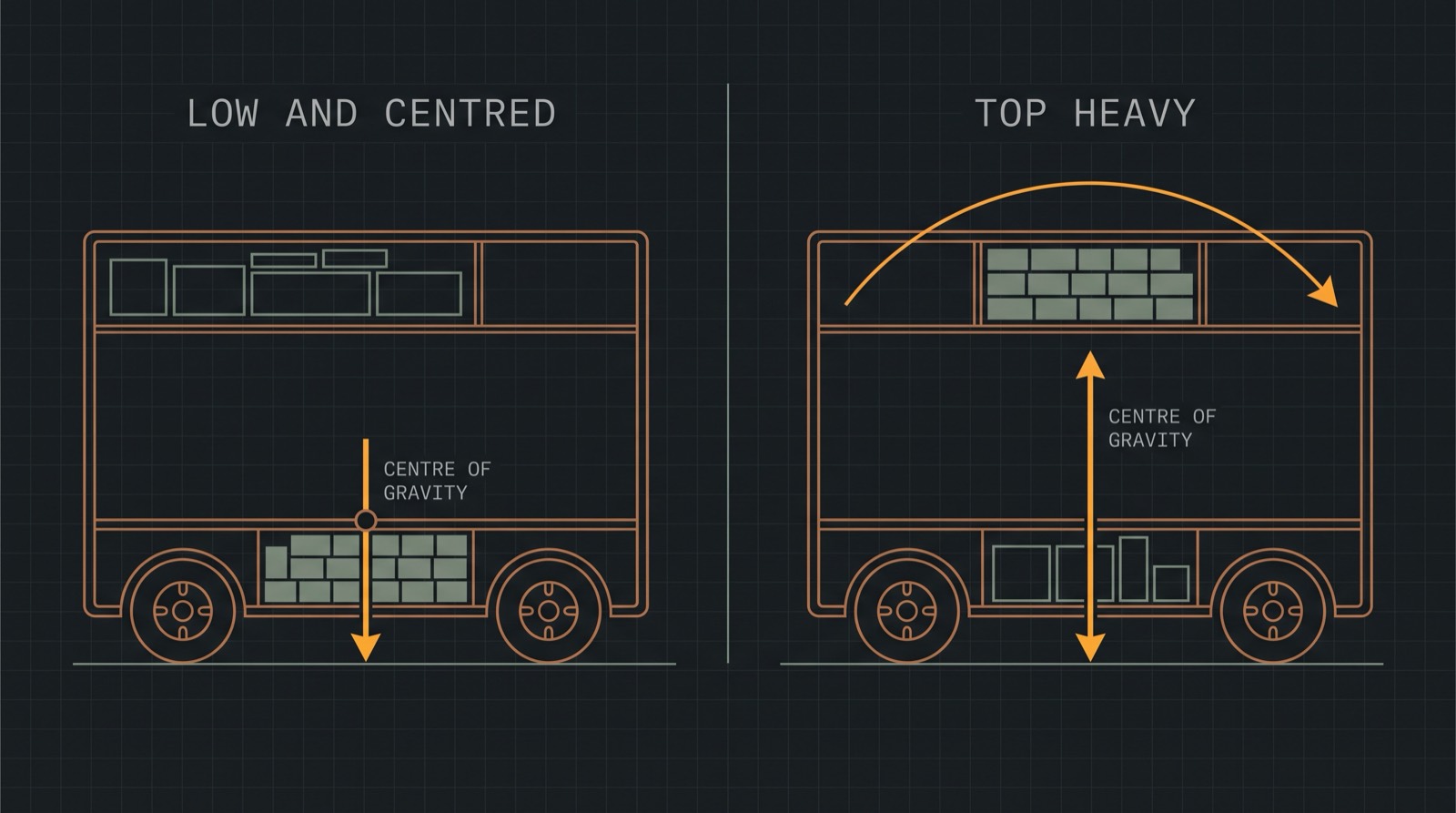
Within that budget, placement changes how the vehicle behaves:
- Heavy things low. Weight high up raises the centre of gravity and makes the vehicle roll more in crosswinds and corners. Tinned food belongs in a floor locker, not an overhead.
- Heavy things central. Weight at the extreme front or rear has leverage over the axles and affects handling out of proportion to its mass.
- Balanced side to side. Uneven loading wears tyres unevenly and shows up on a weighbridge as one axle end over its limit even when the total is fine.
Stacking bins is the common trap. It is genuinely good use of vertical space and it moves weight upward, so keep the light and bulky things, bedding, clothes, dry goods, in the stacked and overhead spaces, and reserve the low lockers for anything dense.
If you want to know your actual numbers rather than your estimated ones, take the loaded vehicle over a public weighbridge. It is inexpensive and it is the only figure that is not a guess.
Storage worth building rather than buying
A few things reward being made to fit, because the off-the-shelf version wastes the space around it:
Drawers under a fixed bed. The deepest usable volume in most campers, and almost always underused. Full-extension runners are worth the cost because a drawer you cannot reach the back of is a drawer you fill with things you lose.
A shallow locker in the wall cavity. Between the ribs there is often 30 to 40 mm of depth doing nothing, which is enough for spices, tools or paperbacks on a face-fixed frame.
Vertical dividers in an overhead. Overheads are the worst-shaped space in the vehicle: wide, shallow and prone to avalanche. Dividing them into narrow bays turns them from a pile into shelving.
If you are building any of those, the cut list calculator will work out the sheet count and, more usefully, tell you whether your panel sizes nest onto the plywood actually sold where you live.
One habit worth adopting
Load the vehicle, then drive it somewhere unremarkable for twenty minutes, including a roundabout and a rough surface, and listen. Everything that is going to work loose announces itself in the first half hour, in a car park, rather than on the first evening of a trip.